The Wandering Scot

An occasional travel journal.

Yap: Land of Stone Money

Last week I was on Palau, where I visited a Yapese quarry site. Today I’m 280 miles away on Yap itself, inspecting the resulting money hoards.

There are hundred of surviving “coins”, ranging from 2′ to 8′ across. Some are held communally and displayed in village Money Banks. Some are held by families and displayed in front of houses.

Among the surviving stones, a very few seem to be shiny marble-like rock and maybe that’s how the whole craze started. But many seem to be rather dull gray, even under the weathered surface.

The true history of the stone money is hard to figure out. They seem to have originated about 500 years ago as rare prestige items, obtained with great effort and great risk from across an ocean voyage. As with many status items, there seems to have been a subsequent social one-upmanship pressure to obtain more, bigger, and better ones.

Presumably the prestige came from the great effort of having quarried and fetched them all the way from Palau. So when David O’Keefe started mass production and importing in the late 19th c, the prestige evaporated and the bottom dropped out of the market.  I suspect many of the larger surviving coins are from the O’Keefe phase, but it’s hard to tell.

P.S.  Since I had been a good and diligent tourist, my hotel rewarded me with a Stone Money Cookie with my lunchtime coffee.  🙂

Palau: Stone Money Quarry

I’m on the Pacific island nation of Palau.  Today I was out at the Yapese Quarry at Metuker er a Bisech, where centuries ago brave seafarers from Yap came to quarry out limestone for use as Stone Money.

One giant piece of money was damaged on the way down from the quarry and lies abandoned. Higher up the trail is a large limestone cave that was supposedly the quarry site.  This has fine stalactites and other scenic limestone formations.  The money was either quarried here or (more likely) on limestone outcrops nearby.

Centuries back, carving out the stone money and transporting it across 280 miles of open ocean by canoe to Yap was a very arduous and risky venture, justifying the high prestige value associated with the stone money. But by the latter half of the 19th century, modern metal tools and sailing ships made the money both much easier to quarry and much easier to transport. So there was a boom in production. And then an inevitable bust, as the supply outweighed the demand and the perceived value of new money fell.

Practicalities: You need a boat and guide to reach the quarry.  I had trouble finding a tour company which could arrange this for me.  I thought I had made a reservation with Palau Explorer, but that fell through.  So this morning I went into the Palau Visitors Authority office, who were really helpful.  They contacted an operator and arranged a private tour “if you can leave right now!” for $150.  When I went to the pickup point, it turned out the operator was actually the same Palau Explorer who I’d been trying to contact originally.  Oh well, I guess they had some kind of scheduling conflict.  Anyway, the trip worked out fine in the end!

Haiti: Cap-Haitien

I’m on a short trip to Cap-Haitien, Haiti.

Cap-Haitien is in the North of Haiti, well away from the troubles in Port-au-Prince. It is tolerably safe and also has some of the most interesting historical sights in Haiti, from the time of the Haitian Revolution, when the slaves overthrew the French and established a free black state.

The #1 target on my list was Citadelle Laferrière, which was built by King Henri I (née General Henri Christophe) around 1820 to deter a French return. It’s seriously impressive, perched on top of a mountain, with giant walls, and with more that enough cannon to deter any sane general.

Nearby are the grand ruins of Henri’s palace complex of San Souci. “The greatest palace in the Caribbean.” Designed to impress haughty Europeans.

I also visited a key revolutionary site at Bois Caiman, where supposedly the first revolutionaries bound themselves in a voodoo ceremony in 1791.  They swore to kill all the French, naturally. There’s nothing left of the original site, but the government have constructed two modern ersatz voodoo sites. Not actually for tourists, but rather to highlight to locals what is seen as a key national-origin story.  (I stumbled and grazed my hand on the way up to the sacred voodoo cave, but I mostly managed not to drip any blood inside. I’m sure nothing bad will happen.)

Yemen: Hadhramaut Tour

I’m in Seiyun, Yemen, winding up a short Yemeni tour.  It’s been an enjoyable visit, with lots of rugged semi-desert scenery, traditional villages, historic towns, and a distinctive culture.

To avoid doubt: I’ve been visiting the sane, calm, government-controlled Hadhramaut region of Yemen.  Well away from the not-at-all-sane rebel-controlled North-West.  In Hadhramaut there are a lot of security checkpoints on the roads, but no recent trouble.

I had arranged a private tour through Young Pioneer Tours.  YPT were very helpful and their local operator was very well-organized and on the ball. It was a great tour!

The scenic Wadi Do’an, full of traditional villages. Note the village perched on the rock.

A view of Shibam “The Manhattan of Arabia”, a Unesco site, with its mudbrick towers.

An oddly precarious fortress tower.
A visiting Scotsman in the traditional Yemeni kilt equivalent.

Cairo: Grand Egyptian Museum

Yes, it’s true, after years of delays the Grand Egyptian Museum at Giza is finally open!

They do indeed have many Wonderful Things.  They have almost all the items from Tutankhamun’s Tomb.  All well displayed, in a spacious gallery.  And they have lots and lots of other Good Stuff spread across 12 galleries.

They also have lots of eager visitors, both locals and tourists.  I was the third person into the galleries yesterday and went straight to the Tutankhamun Gallery, and I still found myself in a scrum of photographers at Tutankhamun’s Mask.  It was actually much quieter 10 minutes later, when the over-eager early bird fervor had died down!

P.S. Yes Tutankhamun’s inner coffin really is 240 lbs of solid gold.  Wow.

I’m in Juba, South Sudan.  There aren’t really many tourist sights in South Sudan, but it’s been interesting to see the local culture.  Even although the country is desperately poor, it has managed to reach #1 in at least one area, Transparency International’s Corruption Index!

The most serious alleged corruption is high-level, supposedly around oil and also some entirely undeclared and officially non-existent gold mining. But at a lower level I did get several opportunities to witness Traditional Local Customs. At a street stop, several charming police ladies politely asked us “for some water” and after some joking back and forth, my guide reluctantly coughed up a few dollars to placate their thirst. At a major checkpoint, a policeman demanded to see my passport and then wouldn’t return it until my guide gave him a few dollars. All this happened completely out in the open for all to see.

No photos of course. My guide warned me that the police like to seize smart-alec smart-phones and then demand quite large sums for their return.

I’ve encountered small scale corruption before, but it is generally much more discreet. My guide was surprisingly philosophical about it. Neither the police nor other government officials have been paid for a year, “so of course they have to fend for themselves”. Oh dear.

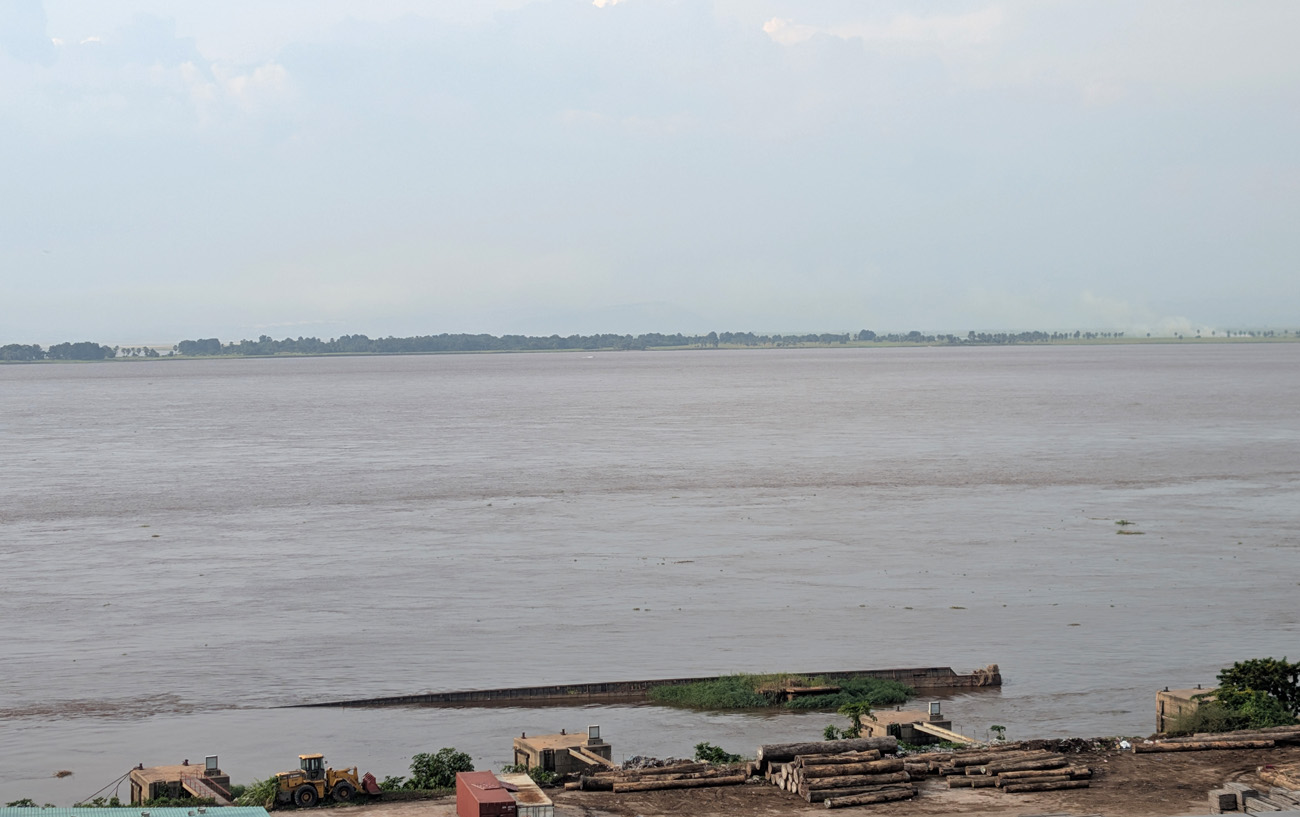
One photo from South Sudan: a wrecked passenger ferry on the Nile. It’s been stuck there for at least a decade, as there are no funds and no motivation to remove it.